

Modernise Java 8 applications without forced runtime upgrades. Discover how Webswing delivers legacy Java apps to the browser without rewriting code.
Modernising a Java application shouldn't mean being forced to upgrade its runtime first. Discover why Java 8 remains a viable choice for business-critical systems, how browser delivery and runtime upgrades can be handled independently, and how Webswing brings legacy Java applications to the browser without unnecessary rewrites, migrations, or infrastructure changes.
The offer had twelve pages and looked fair. The thirteenth page arrived after the signature, was never in the PDF, and was called: first, upgrade your Java. Suddenly a browser-delivery project becomes a project of upgrading the runtime, the dependencies, the builds and the regression tests. All of it before a single user sees a single screen. The most expensive item in a modernisation offer is often not in the offer.
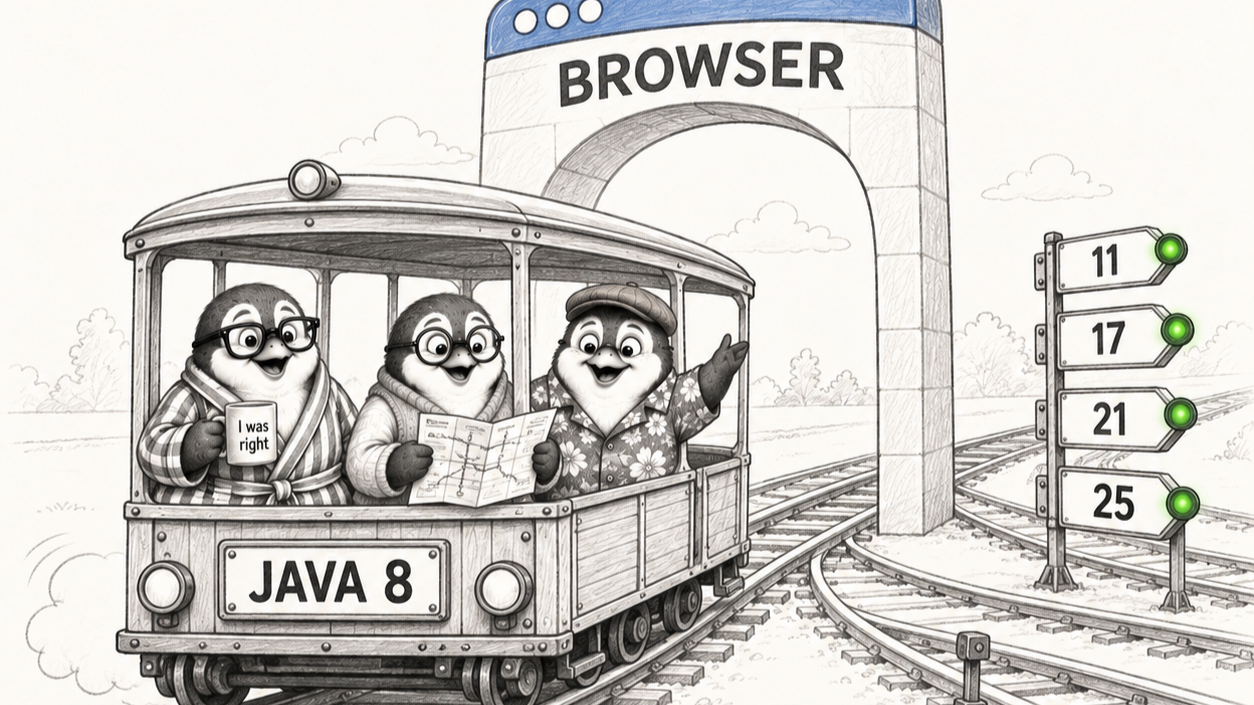
So let us say it out loud: an application has the right to run on the runtime it was built and tested for. Java 8 is nothing to be ashamed of; it is a proven runtime behind thousands of critical systems. Oracle currently lists commercial Extended Support for Java SE 8 through at least December 2030; support conditions differ between Oracle JDK and the individual OpenJDK distributions [1][2]. Upgrade the runtime when it brings value to you: performance, security, features you need. Not as an entry ticket demanded at the door by someone else's tool.
The main idea of this article is simple: delivering an application and upgrading its runtime are two separate decisions with their own best timing. An architecture that fuses them into one mandatory bundle takes the calendar out of your hands. An architecture that keeps them apart gives it back: you make each decision when its cost-benefit ratio is best, with the data you have gathered by then.
Technically, such separation is possible when the delivery layer sits underneath the application, not inside it. In 2012–2014, Webswing's research and development did not focus only on remote display: it tested the possibility of building a web platform implementation on the same standard abstractions Java uses to separate the Windows, X11 and macOS environments, including the java.awt.Toolkit interface [3]. The practical consequence for a customer: browser delivery can be decoupled from a runtime upgrade, and the application can stay on Java 8 until a change actually brings value.
The same independence applies to where the application runs: browser delivery requires neither an external cloud nor a permanent internet connection, so the application can stay on its original runtime and inside the customer's own infrastructure. A compatible application typically reaches the browser without code changes and without a Java change.
The extensibility of the original architectural hypothesis was later tested beyond classic Java desktop applications. It once served applets: when browsers removed NPAPI, they got a server-side path instead of an obituary [4]. And in 2025, Oracle Forms support followed [5]. For a customer, this is evidence that separating an application from the way it is delivered is not tied to one kind of user interface.
And yes, of course the platform also supports newer Java LTS versions, like 11, 17, 21 and 25. Java 8 support is not a technological ceiling; it is the customer's freedom to pick the right moment to upgrade.
Modernisation that begins with an ultimatum is not modernisation. It is a condition of sale.
How many years of proven operation would you have to re-test just to be allowed through the door? A door that asks for that is not yours.
Sources
[1] Oracle Java SE Support Roadmap: https://www.oracle.com/java/technologies/java-se-support-roadmap.html
[2] Oracle Java Client Roadmap Update: https://blogs.oracle.com/java/java-client-roadmap-updates
[3] Webswing Documentation, Overview (platform layer, java.awt.Toolkit): https://www.webswing.org/docs/26.1/overview
[4] Webswing Documentation, Applet launcher (the path after NPAPI removal): https://www.webswing.org/docs/20.1/configure/applet.html
[5] Webswing 25.2, release notes (Oracle Forms support): https://www.webswing.org/en/downloads


