

Java Swing in 2026: Still Relevant, Still Supported, and Ready for the Web Without a Rewrite
Is Java Swing really a dying technology, or just an old one? Age doesn't equal obsolescence, and rewriting a proven application isn't always the smartest move. Discover why Java Swing remains relevant in 2026, why AI-powered migrations still face challenges, and how Webswing helps modernise legacy applications without rewriting years of proven functionality.
When someone declares a technology dead, it is only polite to ask its maker. Java's maker answered in May 2026 on inside.java, with an article and a JavaOne talk pointedly titled The JDK Client Desktop: 2026 and Still Swinging [1]. Swing is part of the JDK, so its technical future is directly connected to the continued development and support of the Java platform itself. The eulogy is postponed, and it is worth asking who ordered it in the first place.
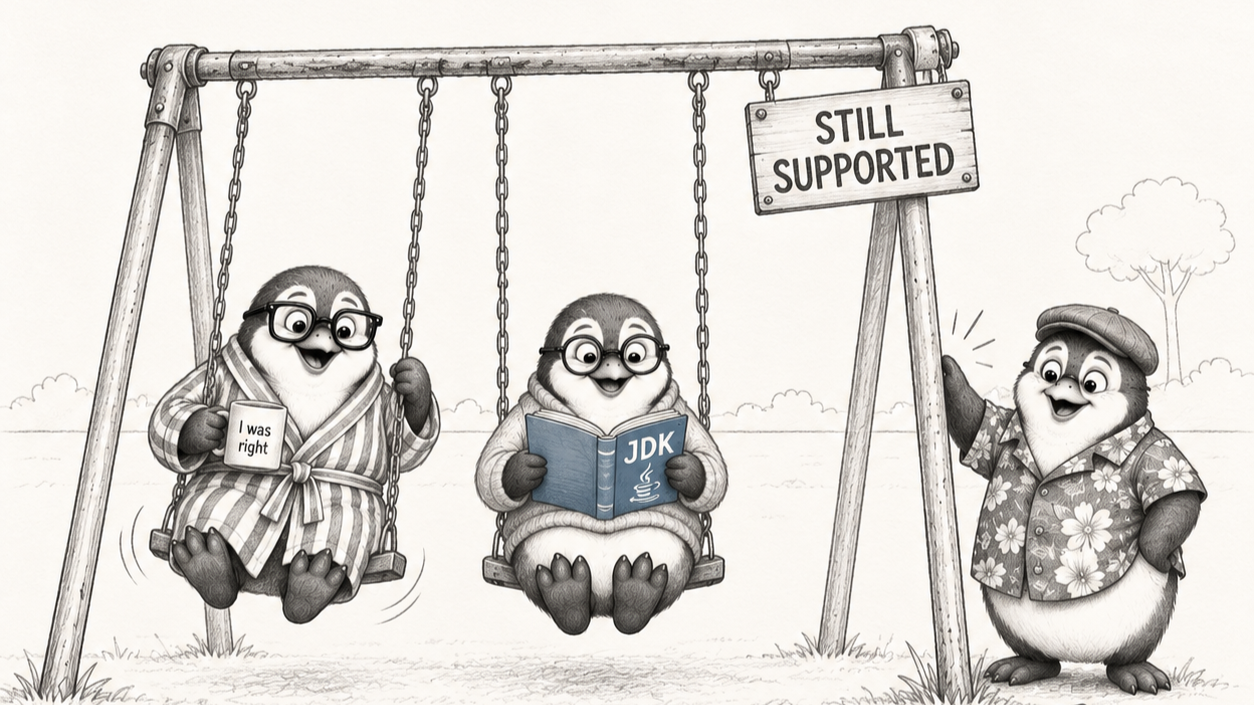
Notice that the phrase "dying technology" never travels with a date or with data. It does not have to; fear is the cheapest marketing channel. Hence the distinction that carries this whole series: old is a date, obsolete is a diagnosis. The date you read from a file header. The diagnosis you have to make: business fit, security, maintainability, availability of people, cost of change. What matters is not when a system was built, but whether it still meets its operational, security and economic requirements.
Novelty, meanwhile, is no proof of viability. A new system can be obsolete on the day it ships if it cannot handle a workflow people have honed for fifteen years. And allow me a personal observation, not a statistic: what has worked reliably for twenty years has at least a stronger proof of viability than a technology that has existed for three.
Nor does artificial intelligence magically solve it. The 2026 ScarfBench benchmark measured behaviour preservation in enterprise Java applications migrated between frameworks across 204 tasks: exactly one attempt produced a fully behaviour-equivalent result, and the strongest agent reached roughly 12.2% aggregate test pass on whole-application tasks [2][3]. The benchmark covers migration between Spring, Jakarta EE and Quarkus, not Swing UI, so treat it as an analogy for the difficulty of behaviour-preserving migration, not a study of Swing. Which makes it all the more telling how hard the task is even where agents have the most training data.
Preserving behaviour instead of rewriting is, in fact, a testable technical hypothesis, and Webswing's research line has been testing it since 2012: an older Java application does not need to be rewritten to gain a new way of being delivered [4]. A customer keeps years of validated behaviour and changes only the way users connect to it.
A note for those who started a grand rewrite years ago and are rewriting still: try to answer honestly, as an accounting question rather than a rhetorical one, whether the original application would have served the business better had you let it live. Make the diagnosis yourself; the data is in your own operations.
Which technology in your company has been officially dying for twenty years and still carries the payroll?
Sources
[1] Inside Java: The JDK Client Desktop, 2026 and Still Swinging (May 2026): https://inside.java/2026/05/03/jdk-client-desktop/
[2] ScarfBench: A Benchmark for Cross-Framework Application Migration in Enterprise Java (arXiv, 2026): https://arxiv.org/abs/2605.06754
[3] IBM Research, ScarfBench announcement: https://www.ibm.com/new/announcements/scarfbench-a-public-benchmark-for-java-framework-migration
[4] Webswing Documentation, Overview (server-side delivery of Java desktop applications): https://www.webswing.org/docs/26.1/overview
arrow_back_ios


